Wellness
 Rewards
 Recognitions


 Learn more about Wellable's all-in-one
employee engagement platform
Learn more about Wellable's all-in-one
employee engagement platform







Pressed for time? Here’s a quick summary…
- Corporate wellness program costs vary widely, with digital platforms typically ranging from $3 to $12 per employee per month, while higher-touch or niche wellness solutions can cost significantly more.
- Total costs increase based on factors like company size, program scope, and participation, plus add-ons, such as health coaching, incentives, and biometric screenings.
- Well-designed, actively used wellness programs can deliver returns ranging from $1.47 to $6 for every dollar spent.
- Building an effective budget requires evaluating cost drivers, hidden expenses, and vendor options to align investments with organizational goals.
HR leaders face growing pressure to justify employee wellness program investments while managing tight budgets and increasing expectations around engagement and retention. During planning cycles, leadership often looks for clear cost breakdowns, ROI projections, and comparisons to other benefits. At the same time, vendor pricing lacks transparency. Proposals vary widely; services are bundled differently; and key costs like implementation, incentives, and reporting are not always included upfront.
Understanding corporate wellness program costs requires a clear view of the factors that drive pricing. Platform fees, service tiers, engagement tools, and add-ons all contribute to total spend, along with less visible elements like onboarding, compliance, and ongoing program management. Evaluating these components together helps organizations build more accurate budgets and make informed decisions.
How Much Does a Corporate Wellness Program Cost?
The chart below provides average platform-only costs (e.g., software) and reflects pricing for a per-employee-per-month (PEPM) model rather than per-user-per-month (PUPM) pricing structure.
| Tier | Cost PEPM | Annual Per Employee | What’s Included |
|---|---|---|---|
| Basic Digital | $1 – $3 | $12 – $36 | Wellness portal, health assessments, challenges, educational content, basic reporting. |
| Mid-Range | $5 – $7.50 | $60 – $90 | All basic features plus calendar integration, custom content, benefits navigation, deeper analytics, expanded communication tools. |
| Comprehensive | $7.50 – $12+ | $90 – $144+ | All mid-range features plus SSO, employee surveys, spousal access, dedicated support. |
- Basic digital: These platforms provide a scalable, cost-effective foundation with mobile and web access, app integrations, personalized dashboards, and core engagement tools. Built for accessibility and ease of use, they offer standard reporting, communication templates, and simple program management capabilities without extensive customization requirements.
- Mid-range: Advanced engagement and administrative capabilities distinguish these platforms from more basic wellness solutions. Features like calendar integration, custom content, benefits navigation, deeper analytics, and expanded communication tools help organizations create more personalized experiences and increase participation. Companies often move into this tier to gain stronger reporting, greater flexibility, and closer alignment with broader workforce initiatives.
- Comprehensive: With enterprise-level integrations and dedicated support, these platforms extend beyond mid-range capabilities. Features such as single sign-on (SSO), employee surveys, and spousal access create a more connected workforce experience. Many solutions also include implementation support, strategic guidance, ongoing optimization, and administrative assistance, making them well suited for large or highly distributed organizations seeking a long-term wellness partner.
What Affects the Cost?

Several factors drive the cost of a corporate wellness program, starting with company size. Larger organizations typically secure lower rates through volume pricing, while smaller companies—especially those with fewer than 100 employees—often face higher costs due to limited scale and negotiating power. However, smaller organizations can offset costs by focusing on digital-first solutions, gradually expanding programs over time, and prioritizing initiatives that maximize participation and engagement.
It is also important to understand how vendors structure pricing. Some charge on a per-employee-per-month (PEPM) basis, meaning organizations pay for every eligible employee regardless of participation. Others use a per-user-per-month (PUPM) model, which charges only for employees who actively use the platform. While PUPM pricing may appear more affordable upfront, costs can increase as participation grows. Understanding which pricing model a vendor uses is critical when comparing proposals and estimating total employee wellness program costs.
Program scope also shapes pricing. Digital-first platforms often provide the most cost-effective option, particularly for remote or distributed teams, because they scale efficiently across large populations. Programs that incorporate on-site services, live events (e.g., fitness classes), biometric screenings, or other high-touch experiences typically require greater staffing, coordination, and logistical support, which increases overall costs.
Customization and participation play an equally important role. Branded content, tailored challenges, and integrations with systems like HRIS require additional resources and development. However, cost alone does not determine value. For example, the cheapest platform is rarely the most cost-effective. A $3 PEPM program with 40% engagement will deliver far more value (e.g., boosted morale, reduced absenteeism) than a $1 PEPM option that employees do not use.
Add-On Costs to Budget For

Many organizations underestimate the true cost of a wellness program by focusing only on platform pricing. Several add-on expenses significantly impact total investment:
- Biometric screenings: Typically range from $36 to $80 per employee per event, depending on whether screenings are conducted on-site or through lab partners. However, many organizations are moving away from biometric screenings due to limited evidence of long-term impact, privacy concerns, and low sustained engagement. Lifestyle-based programs, health coaching, and ongoing education often provide more meaningful and scalable wellness initiative outcomes.
- Health coaching: On average, costs an additional $1 to $50 per employee per month, depending on the level of access (platform-facilitated vs. dedicated coach sessions) and company size. Employee health coaching programs include personalized goal setting, accountability check-ins, and support across areas like nutrition, stress management, sleep, physical activity, resilience, and chronic condition prevention. Many organizations now offer coaching broadly to support preventive, whole-person well-being, rather than limiting access to higher-risk populations.
- Recognition and rewards: Annual budgets often range from $100 to $1,200 per employee per year and may include gift cards, wellness stipends, HSA contributions, paid time off, company-sponsored experiences, milestone awards, and peer-to-peer recognition programs. Some organizations also use tiered incentives tied to participation milestones or outcomes to drive sustained engagement.
- Implementation and onboarding fees: One-time costs typically range from $1,000 to $10,000+, depending on program complexity and organization size. These fees may cover platform configuration, branding, eligibility file setup, communications planning, and integrations with systems like benefits platforms. More customized or enterprise-level programs, especially those requiring multiple integrations or global rollouts, can fall on the higher end of the pricing range.
Sample Budget: What Does Pricing Look Like in Practice?
Example: 50 employees
- Basic subscription: 50 x $3 PEPM x 12 = $1,800/year
- Add-ons:
- Health coaching: 50 x $8 PEPM x 12 = $4,800/year
- Incentive budget: 50 x $150 per employee per year = $7,500/year
- Total: $14,100/year ($282 per employee per year)
This example reflects a smaller organization using a cost-effective digital platform with light-touch programming, health coaching, and incentives to drive engagement. Organizations at this level typically manage setup, communications, and ongoing administration internally with limited vendor support.
Example: 500 employees
- Mid-range subscription: 500 x $5 PEPM x 12 = $30,000/year
- Add-ons:
- Health coaching: 500 x $6 PEPM x 12 = $36,000/year
- Health fair: $7,500/year
- Incentive budget: 500 x $100 per employee per year = $50,000/year
- Total: $123,500/year ($247 per employee per year)
This example reflects a more robust program that combines digital infrastructure with targeted services, including health coaching, a health fair, and incentives to boost engagement and encourage healthier habits. A lower PEPM rate also improves cost efficiency at scale, helping organizations expand offerings while maintaining budget efficiency.
Example: 1,000 employees
- Comprehensive subscription: 1,000 x $7.50 PEPM x 12 = $90,000/year
- Add-ons:
- Health coaching: 1,000 x $2 PEPM x 12 = $24,000/year
- Health fair: $15,000/year
- Incentive budget: 1,000 x $100 per employee per year = $100,000/year
- Implementation fee (one-time): $15,000
- Total: $244,000 first year ($244 per employee per year)
- On-going: $229,000/year ($229 per employee per year)
This example reflects a comprehensive program that includes similar add-ons (e.g., health coaching) and a one-time implementation fee. First-year costs are typically higher because they cover onboarding activities that only happen once, including platform configuration, eligibility setup, communications planning, integrations, and launch support. After implementation, ongoing costs generally decrease as organizations shift from setup to long-term program management and optimization. At this level, a dedicated Customer Success Manager also helps reduce the administrative burden on HR teams by handling strategy, participation monitoring, communications, and program adjustments, helping organizations save staff time and operational costs while maintaining stronger engagement and alignment with workforce needs.
Is a Corporate Wellness Program Worth the Cost? ROI Data
Well-designed corporate wellness programs deliver meaningful financial returns. On average, organizations see $3.27 in medical cost savings and $2.73 in reduced absenteeism for every $1 spent. These outcomes reflect the direct impact wellness initiatives can have on healthcare expenses and productivity. Additional data shows that 90% of companies report a positive return on investment, while 85% experience a reduction in sick days after implementing wellness programs.
Real-world results also highlight the value of employee participation and strategic program support. For example, EquipmentShare partnered with Wellable to support more than 5,500 employees across 100+ locations through a full-service wellness program that included continuous incentives, health and on-demand content, and personalized support. In 2025, the company achieved a 65% engagement rate and a 7.1x ROI driven by higher retention among engaged employees.
However, results are not guaranteed. Corporate wellness program design, leadership support, and sustained employee participation play a critical role in driving impact. A well-structured $10 per employee program with strong engagement can generate greater value than a higher-cost program with limited adoption. For a deeper dive into how to measure wellness program ROI and VOI, see Wellable’s complete guide to measuring wellness program returns.
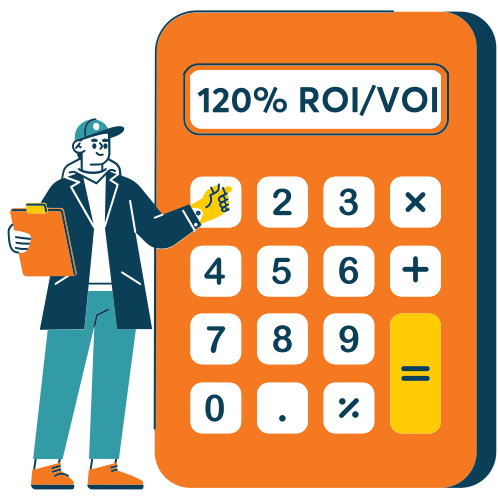
Use Wellable’s ROI & VOI Calculator to measure both the financial returns and the hidden benefits of your wellness programs that impact your bottom line.
ACCESS NOWHidden Costs Most HR Leaders Miss
- Low participation rates: A program priced per employee can quickly become expensive if engagement is low. For example, a $5 PEPM program with 10% participation effectively costs $50 per active user, significantly reducing overall value.
- Platform fragmentation: Using multiple disconnected tools for fitness, mental health, and incentives can lead to overlapping costs, inconsistent user experiences, and lower engagement across programs.
- Manual administration time: Managing a wellness program can require five to ten hours per week from HR teams, including vendor coordination, tracking data, communications, and employee support. For lean teams, this can create hidden strain on internal resources.
- Generic programming: One-size-fits-all content may be easy to deploy but often fails to drive sustained behavior change, limiting impact and return on investment.
- Vendor switching costs: Selecting the wrong platform can result in 6 to 12 months of lost time, including reimplementation, employee re-education, and rebuilding trust and engagement after a poor experience.
How to Build a Wellness Program on a Limited Budget

Building a wellness program on a limited budget starts with making the most of existing resources. Many organizations begin by leveraging free, evidence-based content from sources like the Centers for Disease Control and Prevention (CDC) and National Institutes of Health (NIH), which offer toolkits on topics such as stress management, physical activity, and nutrition. Nonprofits like Mental Health America (MHA) and the American Heart Association also provide educational materials, screenings, and webinars that can be easily shared with employees.
Low-cost programming can still drive strong engagement. Grassroots initiatives like step challenges or stress management workshops require minimal investment, build healthy habits, and foster a culture of well-being. Incentives do not need to be expensive to be effective. Recognition programs, extra paid time off, and peer-to-peer appreciation can motivate participation without adding significant cost.
Starting small also creates an opportunity to test and learn. Running low-cost pilots allows organizations to demonstrate engagement and impact, building a stronger business case for future investment.
Compliance Costs to Factor In
Wellness programs often involve sensitive health data and regulated activities, making it crucial to account for legal requirements during planning and vendor selection. Failing to do so can introduce risk, delay implementation, or require costly program adjustments later.
- HIPAA: Vendors must be compliant and provide a Business Associate Agreement (BAA) to ensure proper handling of protected health information.
- ADA: Incentive structures must be inclusive, reasonable, and accessible to employees of all abilities.
- EEOC guidelines: Health-related activities, including screenings, must remain voluntary and free from coercion.
- GINA: Wellness programs must avoid using genetic information (e.g., family medical history) when structuring health risk assessments or making employment-related decisions.
Compliance requirements continue to evolve, making it important to partner with vendors that stay current with legal standards and proactively adapt programs to remain compliant.
How to Evaluate Vendors Without Overpaying
Choosing the right wellness vendor requires more than comparing price points. A lower upfront cost can quickly become expensive if key services are missing, engagement is low, or additional fees surface over time. Asking the right questions early helps clarify total cost, expected outcomes, and long-term fit.
When evaluating vendors, focus on transparency, support, and proven impact using the questions below:
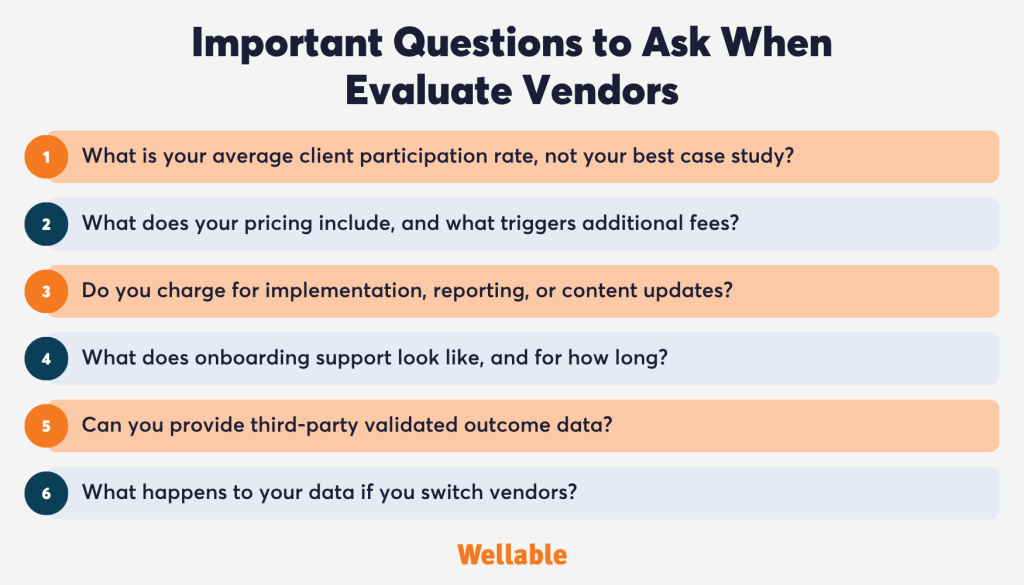
Ready to start evaluating your options? Use Wellable’s Employee Wellness Program Builder to identify the right program mix for your organization.
Build a Program that Delivers
Corporate wellness program costs vary widely, and well-designed programs consistently deliver strong value for employees and organizations. The goal is not to spend the least; it is to invest in solutions that boost engagement, behavior change, and measurable outcomes.
Frequently Asked Questions
-
Share
-

-

-

-