Wellness
 Rewards
 Recognitions


 Learn more about Wellable's all-in-one
employee engagement platform
Learn more about Wellable's all-in-one
employee engagement platform





In this week’s episode, Nick sits down with Chris Williams, former VP of HR at Microsoft and leadership advisor to senior executives worldwide. Chris joined Microsoft through the acquisition of FoxPro and eventually oversaw HR for 32,000 employees under Steve Ballmer before branching off into leadership coaching and development. The conversation covers why cutting middle management creates problems companies won’t feel for years, how AI can genuinely augment managers without replacing them, why most companies handle layoffs badly, and his prediction that we are currently in an AI bubble.


Short on time? Here are the key takeaways:
- Flattening organizations by eliminating middle management creates hidden career traps, including employees having little room to develop management skills incrementally, which can result in some leaving for organizations that offer a path to grow
- Chris predicts a retention crisis in three to five years for companies making extreme cuts to create flat orgs today
- AI cannot replace the interpersonal nuances of management (e.g., writing performance reviews, handling personnel conflicts, recognizing when someone shuts down after a certain type of feedback) but can help managers track communication patterns and manage more people effectively, making 8 to 12 direct reports realistic instead of the traditional 4 to 6
- Companies are terrible at communicating layoffs: they focus entirely on the 1% being let go while ignoring the 99% who remain and are left anxious, uncertain, and quietly polishing their resumes without any clear communication about what the layoff means for them
- Much of what is being attributed to AI-driven layoffs is post-COVID hiring correction: companies that massively over-hired in 2020 through 2022 are now right-sizing, and the AI narrative is a convenient frame for what is also a structural adjustment
- Chris’s prediction: we are in an AI bubble that will correct, similar to the dotcom era—AI is a genuinely powerful tool, but companies making reckless decisions about management layers and headcount will walk many of those back within three to five years
Episode Summary
The Hidden Cost of Flattening Organizations
The trend toward eliminating middle management layers has been accelerating across tech. Jensen Huang runs NVIDIA with 61 direct reports. Jack Dorsey envisions Block with AI effectively managing thousands of employees. Chris’s reaction is pointed and grounded in decades of experience watching organizations evolve: a meeting with 61 people is not an effective meeting. Some people will dominate, some will never speak, and the idea that you can extract meaningful management signal from those interactions is wishful thinking.
The deeper problem with flat organizations is not what companies feel immediately but what they will feel in three to five years. When an organization has only two layers, people have nowhere to grow. You cannot develop an employee from individual contributor to senior manager if there are no intermediate steps on the ladder. People who want to grow, who want more responsibility, who want to learn management at increasing levels of complexity, will leave for organizations that offer those opportunities.
That said, Chris is clear that some organizational bloat is real. Organizations do naturally gain weight in the middle over time, adding management layers that serve promotion paths more than they serve the actual work. The error many are making is overcorrection by eliminating the layers that serve genuine development, mentorship, and interpersonal management functions that AI cannot replicate.
Where AI Can Actually Help Managers
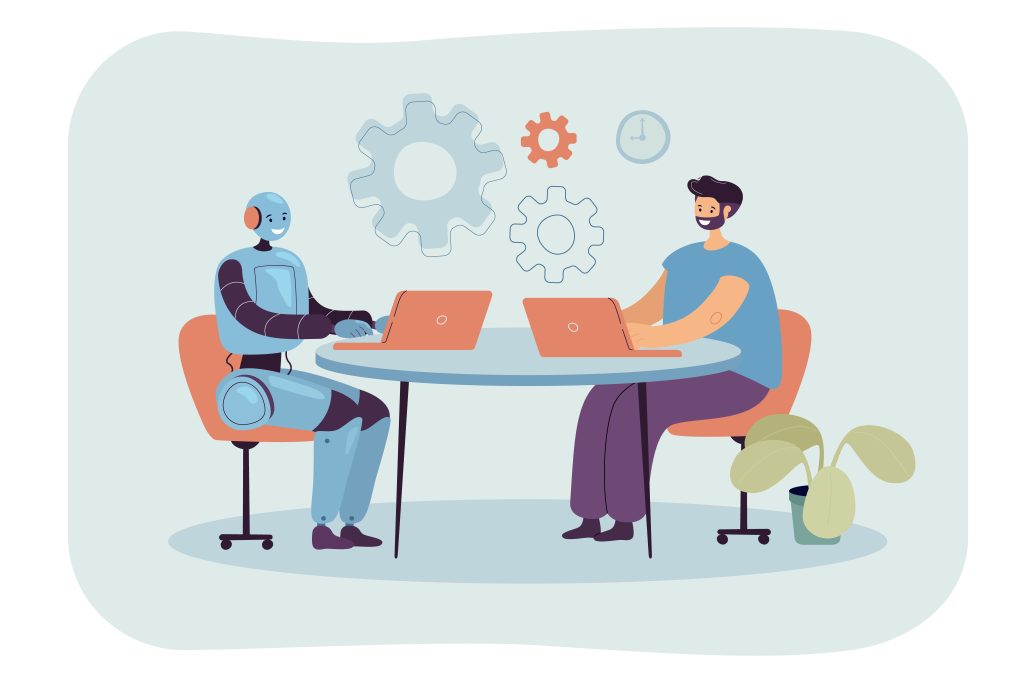
Chris is an enthusiastic daily AI user who builds his own business software through vibe-coded AI tools. His endorsement of AI as a management augmentation tool is therefore not theoretical. His practical argument is that AI can help managers understand, track, and communicate more effectively with each individual on their team in ways that would otherwise require significantly more time.
Chris’s traditional recommendation was four to six direct reports. With AI augmentation, he sees eight to twelve as genuinely achievable—not because the interpersonal work disappears, but because the cognitive load of tracking individual communication styles, preferences, and responses can be partially offloaded to tools. What AI cannot do is make the actual judgment calls: deciding whether to promote someone, how to handle a personnel conflict, what someone’s behavior says about what they need. The nuances of individual human beings, their caregiving responsibilities, their health situations, their personal history and how it shapes the way they hear feedback, are not extractable from a data pipeline.
The California AI Surveillance Bill and Where the Line Is
Nick raises California’s attempt to restrict AI that analyzes facial expressions, tone of voice, and emotional signals in the workplace. Chris’s view is that the reaction is partially warranted but partially an overreaction. The line between useful and creepy is real, and the tech industry has a poor track record of knowing where it is.
Useful: an AI that analyzes a meeting transcript and comes back to a manager saying you repeated the same point four times without acknowledging what the other person said, and suggests a different approach. This is essentially what a skilled HR advisor would do if they had reviewed the meeting, and the fact that an AI can do it at scale for every manager rather than only the ones lucky enough to have an attentive HR partner is genuinely valuable. Not useful: tracking that someone is consistently late on the 17th of every month. That kind of surveillance crosses from coaching into monitoring in ways that erode trust and create legitimate legal and ethical exposure.
Chris’s conclusion is that AI should make suggestions, not determinative decisions. Just as a colleague or an HR advisor can make a recommendation about how to handle a situation without being the one who decides, AI fits naturally into the same advisory role. The moment it becomes the decision-maker rather than the advisor, the problems begin.
Why Most Companies Handle Layoffs Badly
Chris has a consistent and pointed critique of how large companies conduct layoffs: they focus entirely on the 1% of employees being let go while paying almost no attention to the 99% who remain.
The scenario plays out the same way repeatedly. A company announces a large layoff. The communication focuses on the people leaving (e.g., what they are receiving, how the company thanks them, what support is available). The people who remain wake up the next morning with none of those questions answered. Are they safe? Is their team next? Should they start looking? What does this mean for their workload? Most companies leave all of those questions unanswered, and the result is an entire organization distracted, anxious, and quietly polishing their resumes.
The fix, in Chris’s view, is not complicated but requires planning that most companies skip. Layoffs are rarely random across the entire organization. They tend to hit specific divisions, specific product lines, or specific functions. The leaders of those areas should be meeting face-to-face or in small groups with the people affected, explaining why the decision was made, what it means going forward, and what support is available. Meanwhile, communications to the broader organization should be explicit: here is why we did this, here is what it means for you, here is our plan going forward.
The AI Bubble Prediction
Chris’s prediction is contrarian and grounded in historical pattern recognition. We are in an AI bubble, and it will correct. The dotcom analogy is imperfect but instructive: pets.com was real, but so was amazon.com. The bubble produced both. The AI wave is producing both genuinely transformative technology and genuinely reckless decisions (e.g., eliminating middle management altogether, replacing HR functions with agents, laying off thousands of people and rehiring many of them within the same year).
What gives him some confidence that the correction will be shorter and less painful than the dotcom crash is the speed at which business cycles are now moving. The adoption curves that used to unfold over years are now playing out in months. Whatever recalibration is coming may happen faster. The endpoint, in Chris’s view, is a world in which AI is an incredibly powerful tool that helps people do their jobs better—not the end of management, not the replacement of human judgment, not the savior of every business problem.
Frequently Asked Questions
Chris argues that flat organizations create hidden career traps. When there are only two organizational layers, employees have nowhere to grow and cannot develop management skills incrementally. People who want career advancement, more responsibility, and the ability to develop as leaders will leave for organizations that offer a genuine path. Companies that feel the short-term efficiency benefit of cutting middle management will begin to see the talent retention consequences in three to five years.
Chris’s view is no, at least not in any meaningful sense. AI cannot handle the interpersonal nuances of management: the difference between an employee who needs direct feedback and one who shuts down when spoken to harshly, the contextual awareness of someone’s personal circumstances affecting their work, or the judgment required to make real personnel decisions. What AI can do is help managers understand and communicate more effectively with individuals on their teams, making it realistic for a manager to handle 8 to 12 direct reports instead of the traditional 4 to 6.
Chris argues that most companies focus entirely on the experience of the people being let go while neglecting the 99% who remain. A well-handled layoff involves direct, small-group or one-on-one communication with affected employees, and explicit organization-wide communication explaining why the layoff happened, what it means for people who remain, and what the path forward looks like. Most layoffs are handled reactively without that planning, leaving the surviving workforce anxious and distracted.
Not entirely. Chris points out that many tech companies massively over-hired during the COVID pandemic in 2020, 2021, and 2022, anticipating market growth that did not materialize. The current wave of cuts is partly a correction to that hiring excess, and the AI narrative is serving as a convenient framing for what is also a post-pandemic right-sizing. Both things are true simultaneously.
Chris predicts that the current AI moment is over-heated in ways that will produce a correction, similar to the dotcom bubble. Companies are making decisions — eliminating management layers, replacing HR functions with agents — that reflect a misunderstanding of what AI can and cannot do. The bubble will correct, some of those decisions will be reversed, and the endpoint will be AI as a powerful but bounded tool that augments human judgment rather than replacing it.
When 67% of job seekers say they modify their personality to align with company culture and 80% of Gen Z do so, Chris reframes the data as less novel than it appears. People of color and women have been code-switching in workplace environments for decades, adapting their behavior to majority-culture norms in order to be hired and heard. Gen Z is describing a practice that has always existed — what is new is that more people are naming it. His view is that some degree of adaptation to a professional environment is both normal and reasonable, and that managers should meet employees halfway rather than requiring full conformity.
Full Episode Transcript
Nick: Welcome to the Wellable Weekly Podcast, where we talk about key topics and trends at the intersection of wellbeing, technology, and HR. I’m your host, Nick. I’m here with a very special guest, Chris Williams. Chris is a leadership advisor to senior executives with over 50 years of leadership and management experience. Probably most notably, he was VP of HR for Microsoft, covering HR for over 32,000 people. Chris, welcome to the show.
Chris: Good to see you, Nick. Thanks for having me on. I do want to clarify — I don’t have 50 years in HR specifically; I have 50 years in leadership and management. I actually began as a technologist. I wrote software for a living, including a product called FoxPro, which was one of the first high-performance relational databases on PCs. We sold that to Microsoft, and that’s how I got there. I ran larger and larger organizations at Microsoft, including a team of 500 people that built Microsoft Visual Studio. One day the HR leader came to me and said I should be in HR. I said they should be committed. But I made the career change, learned how HR works, and eventually became VP of HR working for Steve Ballmer. I’ve been out of the company for a while now, but I pay close attention and spend my time consulting for large organizations worldwide.
Nick: How does an engineer get asked to move into an HR role? What triggered that?
Chris: I had exposure across the entire organization through a role that reported to Mike Maples, who was number three at the company. I knew all the leaders of the teams that built Word, Windows, SQL Server, and Exchange. At one point I also took on a project to build consistent career ladders across Microsoft — at the time, there were none. Different teams had completely different leveling structures. I spent eight or nine months working with HR and every single team across the company, building a coherent career ladder for developers, testers, program managers, documentation writers, marketing people. That gave me deep exposure to HR and to the whole organization. When the time came and someone suggested I make the move, I figured I could either retire — the stock had gone up 32-fold — or do something completely different. I went to HR. I was not welcomed with open arms because I didn’t come up through HR. But I spent a year learning, and I also served as what I call an HR translator. HR loves to use jargon — empowerment, enablement, engagement — words that line managers hear and immediately tune out. I would go to senior technical leaders and explain what empowerment actually looks like in practice. What do you do differently tomorrow? I would go to HR and say: stop using those words, because people don’t understand what you’re talking about. That translation function turned out to be incredibly valuable in both directions.
Nick: You mentioned career ladders at Microsoft. Today we’re seeing the opposite conversation — big tech companies eliminating middle management layers. Jack Dorsey says he envisions a future where all 6,000 Block employees report to an AI version of him. Jensen Huang runs NVIDIA with 61 direct reports. What do you make of that as someone who spent years building organizational structure?
Chris: Jensen Huang with 61 direct reports — I honestly don’t understand how that functionally works. A meeting with 61 people is never an effective meeting. Some people will talk constantly and some will never say a word. It just isn’t a functional way to manage people. On the broader trend: organizations do naturally bloat in the middle. They add weight because it becomes easier to create promotion paths that way. I understand why people are trying to flatten. But what they’re losing sight of is that when you have only two organizational layers, there is no place for people to grow. You can either be a line person or suddenly you’re reporting to the CEO. Those are two completely different jobs with no intermediate steps. People who want more responsibility, who want to develop as managers and leaders, will leave for organizations that offer that path. I predict that many of these companies will find in three to five years that they have a serious retention problem because the growth opportunities just aren’t there. On the Jack Dorsey vision — I think that if you believe AI can make decisions about interpersonal relationship issues or personality nuances, you probably haven’t used AI enough. I use AI all day, every day. But write up a performance review in AI and look at the results. They’re generic. They don’t account for the fact that someone’s mother is ill, or that this person is a recent cancer survivor, or that this person responds to direct feedback with total shutdown while the person next to them only hears you when you’re blunt. Those nuances can’t be outsourced to AI.
Nick: What about AI as an augmentation tool — not replacing managers, but helping a manager handle more people?
Chris: I strongly believe in that. I’ve lived through major efficiency transitions — pre-Excel, pre-email, pre-cell phones — and each one brought incredible new capabilities that changed how work happened. AI is doing that at a much larger scale and much faster pace. What I think AI can do is help managers understand the individuals on their teams better. Imagine an AI that notices the last two meetings you had with someone, she recoiled every time you addressed the topic in a particular way, and prompts you before the next meeting to try a different approach. Or an AI that surfaces the fact that someone hasn’t responded to your last three emails and suggests you try a spoken conversation instead. That’s the kind of pattern-recognition that attentive managers develop over time but that AI can surface immediately and at scale. My traditional recommendation was four to six direct reports. With AI augmentation, I think eight to twelve is genuinely achievable. What AI cannot do is make the actual decisions — whether to promote someone, how to handle a conflict, what a person’s behavior really means. That’s irreducibly human.
Nick: California is trying to restrict AI that analyzes facial expressions, tone of voice, and emotional signals in the workplace. Where’s the line between useful and creepy?
Chris: Those lines are real, and the tech industry has a pretty bad track record of knowing where they are. I think some of the California reaction is an overreaction, because one of the most useful things I try to teach managers is how to read signals that other people are sending. A lot of managers, particularly in tech, simply don’t pick up on them. An AI that analyzes a meeting transcript and comes back to you saying “you repeated the same point four times without acknowledging what the other person said, maybe try a different approach” — that’s essentially what a skilled HR advisor would tell you if they’d reviewed the meeting. Having AI do that at scale for every manager is genuinely valuable. What I’m not okay with is tracking that someone is always late on the 17th of the month, or anything that starts getting into personal surveillance. The principle I’d use: AI should make suggestions, not determinative decisions. The moment AI becomes the decision-maker rather than the advisor, the problems begin.
Nick: On code-switching — the article in Wellable Weekly noted that 67% of job seekers modify their personality to align with company culture, and 80% of Gen Z do so. How should managers think about that?
Chris: This is measurement bias, and I don’t think it’s new. Ask any African American employee how they behaved in the ’80s, ’90s, or 2000s. They were code-switching constantly in order to get and keep jobs. Women have had to do it for years — being more aggressive to be heard at all, or more passive to avoid a label. People have been doing this since the beginning of workplace culture. What’s new is that more people are being honest about naming it. I’d also point out that everybody changes how they present themselves for work. You think about what you’re wearing, you steel yourself for a difficult meeting, you calibrate your tone for the audience. That’s just professionalism. Where I think managers need to stay honest is in recognizing that the person they’re seeing may not be the whole person — particularly for someone from a background where adapting to majority-culture norms has always been a survival skill. The goal should be managers meeting employees halfway. You come and try to be effective in a professional context, and I’ll try to manage you in a way that actually works for you.
Nick: How should big companies be handling layoffs better than they currently are?
Chris: Companies are just bad at this. Two things drive me crazy. First, there is no humanity. Waking up to a text message that says you don’t work here anymore is terrible. But the second thing — and this is the one nobody talks about — is the 99%. Companies lay off 1% of their workforce and spend all their energy on those people. Meanwhile, the other 99% are sitting there wondering whether they’re next, whether they should be polishing their resume, whether they should be looking for other jobs. And the company pays almost no attention to communicating with those people. Here’s why we did this. You are safe. This is our plan going forward. Yes, some of you will have to absorb more work; here’s how we’re going to manage that. None of that happens because most layoff decisions are made reactively — CFO flags a headcount problem, CEO picks an org, people wake up to an email. If you actually planned the process, you’d have division leaders meeting one-on-one or in small groups with affected people, explaining exactly why the decision was made and what support is available. That’s not particularly difficult if you think it through. It just requires planning that most companies skip.
Nick: Much of what’s being attributed to AI-driven layoffs — is it actually about AI?
Chris: Not entirely. We need to remember that COVID hiring was insane. If you look at the employment hockey stick at virtually every tech company from 2020 to 2022, they were hiring hand over fist because they thought the world was permanently changed and their markets were going to the moon. Then in 2024 and 2025 they woke up and realized they didn’t have anything to keep those people busy and their numbers weren’t where they’d projected. A lot of what’s being called AI-driven restructuring is really just correcting a COVID-era hiring overshoot. The AI narrative is a convenient frame for what is also a right-sizing.
Nick: Prediction — what’s coming that people aren’t thinking about?
Chris: We are in an AI bubble, and it will correct. I’ve lived through the dotcom era. pets.com was real, and so was amazon.com. The bubble produced both. The AI wave is producing both genuinely transformative technology and genuinely reckless decisions — eliminating management layers, replacing HR with agents, laying off thousands of people and rehiring many of them within nine months. Companies are going to find that the death of middle management is both unhealthy for organizations and wildly exaggerated. The interpersonal nuances of managing human beings cannot be outsourced to AI. In three to five years, we will have found out that AI is an incredibly powerful tool that helps us do amazing things — but it is neither the end of everything nor the savior of everything. The companies making the most extreme bets right now will walk many of those back. I’m hoping the correction is faster than the dotcom correction was, because business cycles are moving faster than they used to. But a correction is coming.
Nick: Where can listeners find your work?
Chris: Search CL Will — C-L W-I-L-L — and you’ll find me everywhere. I’m on YouTube, Threads, and TikTok where I have a quarter of a million followers. You can also go to clwill.com.
Nick: Thank you, Chris. As always, thank you to our listeners for tuning in. You can catch us on Apple Podcasts, Spotify, wherever you get your podcasts. Subscribe to the newsletter, and have a great week.
-
Share
-

-

-

-