Wellness
 Rewards
 Recognitions


 Learn more about Wellable's all-in-one
employee engagement platform
Learn more about Wellable's all-in-one
employee engagement platform




In this episode of Wellable Weekly, Nick and Geoff cover two topics shaping today’s workforce. First, they explore the social underdevelopment challenge facing Gen Z workers—and why reduced dating, socializing, and risk-taking is showing up as a real skills gap in the workplace. Then they turn to the broader economic picture: stagnant job growth, falling pay for job-switchers, and the highest proportion of struggling employees Gallup has ever recorded, and what HR leaders and individuals can do in response to these trends.


Short on time? Here are the key takeaways:
- Only about 56% of Gen Z enter adulthood having engaged in a romantic relationship, versus roughly 75% of older generations, signaling reduced exposure to the communication and compromise that build interpersonal skills.
- Gen Z is socializing less overall, contributing to underdeveloped skills that are critical for workplace success, including navigating conflict, taking risks, and sustaining professional relationships.
- In-person work environments can accelerate the development of communication and collaboration skills that are harder to build in remote or hybrid settings.
- 27% of employees who changed jobs recently took a pay cut, highlighting a meaningful shift in job market dynamics and reduced worker bargaining power.
- Only 28% of US workers report feeling secure in their current job, reflecting widespread economic anxiety.
- Job growth remains effectively stagnant, with near-zero net new jobs created in recent data, reinforcing concerns about labor market stability.
- For the first time in Gallup’s tracking history, more employees report “struggling” than “thriving,” with significant implications for engagement, productivity, and wellbeing.
- Upskilling, especially in response to AI and evolving job requirements, is increasingly critical for job security and career advancement.
Episode Summary
This week’s episode covers two topics that are shaping organizational culture, productivity, and employee engagement, and what employers and employees can do about it.
The first comes from a story about Gen Z dating less and what that means for workplace readiness. Nick frames the generational boundaries quickly—Gen Z runs from 1996 to 2012, meaning the oldest members are approaching 30 and represent a substantial, growing share of the workforce. By 2030, Gen Z is projected to make up 30% of the U.S. workforce, or roughly 50 million people.
The headline statistic driving the conversation: only about 56% of Gen Z have ever engaged in a romantic relationship, compared to approximately 75% of older generations. Nick and Geoff quickly widen the lens. Romantic relationships are just one data point in a broader pattern of reduced social exposure—less in-person socializing, less drinking, fewer happy hours, even lower rates of getting a driver’s license. Nick’s framing is that driving a car is itself a risk-taking behavior that builds broader life skills, and when you remove the social motivation to go somewhere, the development that comes with it disappears too.
The core issue, as both hosts see it, is that workplace relationships are inherently hard. Disagreements with colleagues, tough conversations with managers, and navigating conflict with clients all require a tolerance for discomfort and a skill set built through repeated exposure to exactly those kinds of situations. Gen Z has simply had less of that exposure. The pandemic, the rise of social media, and remote-first norms during formative years all contributed to a generation entering the workforce with a real gap in what Nick calls the “risk-on” orientation that professional environments demand.
Geoff illustrates this vividly with an anecdote: younger workers he knows describe checking a dating app to see if someone at a bar is on it before deciding whether to approach them—using the app as a signal of receptiveness rather than just walking over. The implication is that risk avoidance is becoming the default, and that same instinct shows up in professional settings, making difficult conversations harder to initiate and conflict harder to work through.
For employers, both hosts land on a similar conclusion: in-person work is probably the best accelerant for catching up this development gap. Remote and hybrid environments make it too easy to disengage—to go on do-not-disturb, to not respond to a message, to avoid the friction that actually builds the muscle. An office environment removes some of that escape, creating the repeated low-stakes discomfort that leads to growth. Nick is careful to note this isn’t about punishing remote workers, but about recognizing that for a generation that needs relational reps, physical proximity matters.
His advice to Gen Z workers themselves: treat relationship-building as a skill, not a personality trait. Like any skill, it requires uncomfortable practice. Knowing you’re underdeveloped in an area is actually the advantage. It means the ceiling is high, and the path is learnable.
The second topic of the episode is what Nick calls “economic malaise.” A cluster of recent data points from ZipRecruiter, ADP, Gallup, and job growth reports all tell a consistent story: workers are anxious, the labor market is soft, and the usual levers for advancement aren’t working the way they used to.
The ZipRecruiter finding that stood out: 27% of people who recently changed jobs took a pay cut. Another 16% made the same salary. That means only a little over half of job-switchers actually came out ahead. This is a sharp departure from the conventional wisdom, especially in knowledge worker industries, that changing jobs was the fastest path to a raise.
The ADP data is equally striking: only 28% of U.S. workers report feeling safe in their current job. That means nearly three in four workers are carrying some degree of job insecurity. The macro backdrop doesn’t help. Job creation has slowed to nearly zero, with no strong signals that the rest of 2026 will see meaningful change.
The Gallup data may be the most significant: for the first time in the history of their life evaluation index, more employees describe themselves as “struggling” than “thriving.”
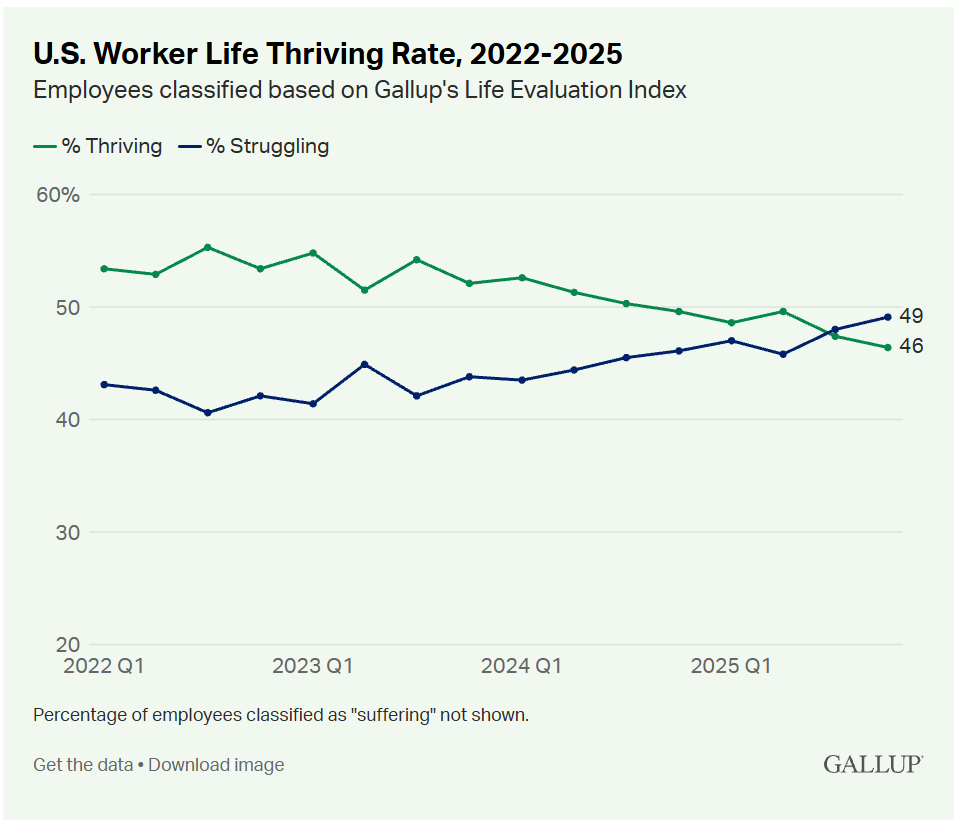
Geoff walks through what that means in practice—more absenteeism, more active job searching, more health problems, less engagement. For employers, a workforce where struggling outnumbers thriving is a workforce that’s hard to retain, hard to motivate, and harder to lead.
Nick acknowledges this is a tough topic to wrap a bow on. The obvious answers—upskill, get comfortable with AI—are true but also fairly well-worn. His most concrete guidance: if you’re in the job market, remember that the majority of job-switchers still come out at the same level or higher. Know why you’re leaving. If the answer is just to escape, you may end up somewhere worse.
Frequently Asked Questions
Romantic relationships are one of many experiences that build communication, compromise, and conflict-resolution skills. The same interpersonal muscles developed through close relationships—whether romantic or platonic—are exactly what workplace dynamics require. A generation that has had fewer of these formative social experiences is entering the workforce with less practice navigating disagreement, expressing themselves in high-stakes conversations, and tolerating rejection. That gap shows up in real ways when managing up, collaborating across teams, or working through professional conflict.
“Risk-off” describes a pattern of behavior in which Gen Z defaults to avoidance of uncertain or potentially uncomfortable social situations. Whether it’s checking a dating app before approaching someone at a bar, socializing less, or driving less, the pattern reflects a broader tendency to protect against failure or rejection. In professional environments, this same orientation can make it harder to advocate for yourself, have difficult conversations, or take on visible projects—all things that are necessary for career growth.
In-person work is one of the most effective tools for accelerating relational development in the Gen Z workforce. Remote and hybrid settings make it too easy to disengage and avoid interpersonal friction. Physical proximity creates natural, repeated opportunities to practice exactly the kinds of low-stakes social navigation that build professional skill over time. However, simply requiring in-office attendance without ensuring meaningful team interaction misses the point. The quality of those in-person interactions matters as much as the presence requirement itself.
Recent data from ZipRecruiter, ADP, and Gallup paints a cautious picture. Roughly 27% of recent job-changers took a pay cut. Only 28% of U.S. workers feel secure in their current role. Job growth has effectively stalled, with near-zero net new positions created in 2025. For the first time in Gallup’s tracking history, more employees describe themselves as struggling than thriving. Taken together, these figures suggest a labor market that is soft, anxious, and offering fewer of the upward mobility signals workers have come to expect.
What is the Gallup life evaluation index and why is the current reading significant? Gallup’s life evaluation index tracks whether employees consider themselves to be thriving, struggling, or suffering. The recent data shows, for the first time in the survey’s history, that the proportion of employees who are struggling has surpassed those who are thriving. This is significant because struggling employees are statistically more likely to miss work, experience health problems, disengage from their roles, and look for new jobs, all of which create real costs for employers and the broader economy.
Focus on upskilling, particularly around AI competency, as the most durable investment an employee can make right now. Beyond that, job-searching purely as an escape rather than moving toward a better opportunity often leads to worse outcomes. Instead, identify what you’re running toward: a specific skill you want to build, a type of work you find meaningful, or a role that expands your capabilities. That clarity makes the search more focused and the eventual landing more successful, even if the pay is the same or slightly lower in the short term.
Full Episode Transcript
Nick: I was going to take the perspective that, hey, our company was going to have a majority of Gen Z employees or a growing number of Gen Z employees that we have to think about their kind of psyche as they entered the workforce and what that means. The first thing I would think about is, how do you catch up that development? If they’re underdeveloped in this area, how do you catch them up? And I think the best way is in-person work.
Welcome to the Wellable Weekly Podcast, where we talk about key topics and trends at the intersection of wellbeing, technology, and HR. We are a weekly podcast, as everyone knows, and all of our avid listeners are probably wondering why we missed last week’s episode. Unfortunately, we had a loss in the family, so Geoff’s grandmother passed away, and so I figured it should be a good opportunity for us just to celebrate her life briefly.
Geoff: Yeah, thank you for the opportunity to do that. Grandma Regina, Gina, or Gma, as we called her affectionately—kind of the matriarch of our family, 95 years old, just a few days shy of her 96th birthday. So certainly a sad time for us, but again, she lived a great long life and we were lucky to be her grandsons.
Nick: Yeah, I’m sorry for your loss. I know I’ve only met her once, and for those who don’t know, Geoff and I literally work across the desk from each other, so we’re deeply in tune with each other’s personal lives in many ways. The only time I met her was at a wedding, and I met her outside very briefly—we chatted. Everything you’ve told me about her, she lived up to instantly in that short conversation. And then I was with my wife, we went to the bar, I came back to the barn to go to the dance floor, and she was in the center of the mix—dancing it up. I think she was like 94 or 95 at the time. And so I just thought: that’s perfectly emblematic of everything I knew about her. So sorry for your loss, but she sounds like she lived a full life, and I know just from my conversations with you that she had a huge impact on a ton of people she was close to.
Geoff: Absolutely. Yeah, well said.
Nick: So because we missed a week, we’re going to cover two articles in a short-form format, because two weeks ago the Wellable Weekly newsletter had a great article on Gen Z. The headline was something along the lines of: Gen Z are dating less, and that is making it very hard for them to operate in the workforce.
The first thing I thought about was the cutoff for Gen Z—I always ask this because I’m like a millennial, so I’m thinking, what am I? I think the technical definition is 1996 to 2012. So in terms of the workforce, anyone born in 1996 or after is a Gen Z-er. That makes the oldest Gen Z member around 30 right now. Older than you’d think. So the reason I mention that is it’s a substantial portion of the workforce and a growing one. And they’re dating less, which per the article makes it really difficult for them to understand the social etiquette required in the workforce. The key stat: 56% of Gen Z have never engaged in a romantic relationship, versus about 75% of members of other generations. That’s a pretty substantial difference.
Geoff: Yeah. Well, first, I completely relate to how you anchor perceptions of generations based on what you might have thought years ago. To me, a 29 or 30 year old is a millennial, right? But no, to your point, that’s now an older member of Gen Z. And your comment around the significance of this topic—we’ve read a stat that Gen Z is going to represent 30% of the U.S. workforce by 2030. So 50 million people are in this generation we’re talking about today. And the headline is interesting because the obvious question is: what does dating necessarily have to do with the workplace? But I interpreted the article as being about relationships of all kinds—whether romantic or platonic. It’s all the same type of thing: communication, compromise, giving and taking. If we know that Gen Z is dating less, we also know they’re socializing less, drinking less, having fewer face-to-face interactions than any prior generation. There are a few reasons for that—the pandemic era, social media—but bottom line is this entire generation is being exposed to less of the foundational experiences and skill sets that probably shaped our generation.
Nick: Yeah, in summary, relationships are hard. I always think about this when friends or younger coworkers are getting married. If I’m ever asked for advice, I just say: relationships are hard, and if they weren’t, they’re probably not that meaningful. I’ve personally had hard moments in my relationships with my best friends—it doesn’t need to be romantic. But to your point, Gen Z is just less social and has fewer of these interactions. And in the workplace, you’re going to have disagreements with people. It doesn’t matter if you have a personal relationship with them—it’s a formal relationship where you can’t just shut the person out of your life. In a romantic relationship or a really close friendship, you can have a fight, and the next day you still see that person and have to continue. Working through those hard relationships—being able to articulate yourself, express yourself on difficult topics—is a skill. And this generation is just underdeveloped in that area.
More broadly, to your point about socializing and drinking, every stat I read on Gen Z reflects what I’d call a risk-off mentality. In any professional setting, even academia, you have to be somewhat risk-on. Scientists constantly experiment and take risks. Sales reps take risks in how they pitch. And even driving—Gen Z drives at lower rates, mostly because when I was 16, I couldn’t wait to get behind the wheel because I wanted to go see my friends. When you don’t really have that desire to go socialize, you don’t need a car. And driving teaches you not just how to drive—it builds broader life skills. And some of that, per this article, is lacking in the workforce.
Geoff: Right. I’ve heard this from a few younger friends and coworkers in this generation: the approach now, when you’re out and you see someone you might want to strike up a conversation with, is to pull up a dating app and see if they’re on it first. If they are, it might be a sign they’d be receptive to a conversation. If not, you might not go over at all. On one hand, you could view that as a cautious approach to a conversation that could go nowhere—but I think it’s very much on that risk-off mindset, protecting from rejection or harm. And that approach spills over into the workplace. Whether it’s having a tough conversation with a boss, a peer, or a client, all of those things come with stress, pressure, and the potential for letdown or rejection.
Nick: Your bar story is just such a foreign concept to me. Like, what are the odds you find that specific person on the app? There’s always a risk-reward: how much time are you going to spend searching versus the five minutes it takes to just find out?
That said, what do you do with this as an employer? I’ve got to think this is a polarizing comment just because return-to-office and remote work have very opinionated views on both sides. But if I was going to take the perspective that our company would have a majority of Gen Z employees, the first thing I’d think about is: how do you catch up that development? If they’re underdeveloped in this area, how do you get them there? And I think the best way is in-person work. If you’re working remotely, you’re on Teams, on Zoom, maybe not even doing video. You can put yourself on do-not-disturb. You can very easily create barriers. In person, you can’t just walk out and escape when something’s uncomfortable. And that friction is exactly what drives development.
Part of the relationship piece is interacting with people you don’t always like. The hard part isn’t getting along with people you do like—it’s navigating the ones you don’t, or the ones you like but just aren’t jiving with that day. I think the solution to this, and to workplace loneliness more broadly, is on-site work.
Geoff: Yeah, absolutely. There’s a lot of connection between relationship-building, loneliness, and whether you’re working fully remote versus coming into an office. And there’s something to be said for the employer doing their part too—if you’re being asked to come in but your team isn’t there and you’re not having meaningful interactions, you’re not getting the benefit. But I do think in-person work is such an obvious lever for addressing some of the challenges this generation is facing, especially coming up through COVID and entering a workforce unlike anything prior generations experienced.
Nick: Agreed. One last comment: if I had advice to offer individuals in the Gen Z years, not just employers, I’d say treat it like a skill. Whether you’re developed at it or not, you can always get better—myself included. I can always improve my relationships. Because it’s a skill, it’s hard to develop, and it requires work. So if you’re aware of some of these deficiencies in yourself, you’re going to have to go through challenging moments as you put yourself in situations where you’re growing. That difficult moment is the price of admission for growth.
On that note, we’ll move to the next topic.
The difficult time has the best segues, right? I’d call this one “economic malaise.” The Wellable Weekly newsletter this week had one article, but there were really a whole set of data points around this theme that I’d call general frustration, fear, and concern in the economic environment employees are operating in today.
The stat that was actually in the newsletter was from ZipRecruiter: 27% of people who just got new jobs took a pay cut. They left their old job, got a new one, and are now getting paid less. Another 16% got paid the same. The majority still got paid more—but the reason this is a concern is that, historically, almost everyone who left a job for a new one got paid more. So even though this is less than 50%, it’s substantially higher than we’d typically expect.
If you dive into other stats: a global ADP survey found that only 28% of U.S. workers agree they feel safe in their current job. That means three-quarters of people don’t feel secure. Some of that may be the general economic environment—AI, who knows—but that’s a very high number. For job growth, the latest 2025 numbers show about 116,000 net new jobs created, but effectively zero net new jobs when you account for revisions. No real sign that’s changing in 2026. I could go on and on—there are just so many statistics that represent the anxiety people are carrying in today’s economic environment.
Geoff: Right. Low or no overall net job growth. A large percentage of employed workers who don’t feel their job is safe. And of those seeking or making a change, almost a quarter are not seeing a pay increase. Those are three pretty staggering statistics. And that last one—not seeing a pay bump when you switch—was something that was almost taken for granted, especially in tech and knowledge worker industries. That was the most natural way to get ahead, and clearly it’s no longer a given.
The Gallup data is also striking. There’s a chart—we’ll put it up in the YouTube video—showing the convergence of employees who feel they are thriving versus struggling, and for the first time since Gallup began tracking this life evaluation index, there’s now a higher percentage of employees who feel they are struggling than those who are thriving. And you think about what that means for an average employer: people who aren’t thriving are more likely to miss work, more likely to be looking for a new job, more likely to get sick, and generally lower in engagement.
Nick: I always see an article like this and think: we have to talk about this on the podcast. And typically we choose topics where Geoff and I have a clear hot take. This one’s tough because it’s kind of a bummer—a lot of negative news about the economy. And I don’t know what to say beyond the generic feedback: employees need to upskill, AI requires new skills, what was successful five years ago may not be sufficient today. Those are all true, but they’re also pretty obvious.
So the only thing I can try to put a ribbon on is this: if you are looking for a job right now, the current picture is that the majority of people who land a new job will still get a pay raise. If you include people who end up at the same level, a pretty significant portion come out the same or higher—which is, one way to frame it, better than expected. I also always tell people who are thinking about leaving: figure out why you’re leaving. Run toward something, not away from something. If you just hate your current job, that’s fine—but figure out where you’re going. Because if the answer is just “I need to leave,” you often end up somewhere that isn’t great. There are situations where taking a pay cut leads to a much better, happier place. And that can be a win, pay cut aside, if you’re clear on what you’re running toward and you have the skills to be successful in that domain.
Geoff: Yeah, that’s probably a good place to wrap. The upskilling piece is always relevant—probably now more than ever. And I agree: even if it may not be the best time to look for a new job externally, it may be a great time to look internally and figure out what new skills you can develop. Apply those to enrich the experience you have at your current employer. Well, thanks again for listening to this week’s edition of Wellable Weekly. As always, you can subscribe on Apple Podcasts, Spotify, or wherever you get your podcasts. Be sure to check out our Wellable Weekly newsletter and follow us on LinkedIn. Until next time.
-
Share
-

-

-

-