Wellness
 Rewards
 Recognitions


 Learn more about Wellable's all-in-one
employee engagement platform
Learn more about Wellable's all-in-one
employee engagement platform






Short on time? Here are the key takeaways:
- Employee recognition supports engagement, well-being, productivity, and retention by helping employees feel valued, connected, and motivated.
- Build recognition around clear goals, employee needs, and company values to create a program that supports meaningful organizational outcomes.
- Deliver timely, specific, and inclusive recognition, paired with meaningful rewards when appropriate, to reinforce positive behaviors and acknowledge contributions across the workforce.
- Track participation, recognition patterns, engagement, and retention to identify gaps and continuously improve program effectiveness.
Employee recognition is a powerful driver of engagement, performance, and workplace culture. It also plays a major role in supporting occupational wellness, a foundational aspect of holistic well-being that reflects how a person experiences purpose and satisfaction at work. Yet meaningful recognition remains far from universal. As of May 2026, only 29% of U.S. employees reported receiving recognition or praise for doing good work in the previous seven days. This gap highlights an opportunity for organizations to make appreciation a more consistent and intentional part of the employee experience.

What Are Employee Recognition Programs
Employee recognition programs are structured systems that help organizations acknowledge and celebrate employee contributions, milestones, achievements, and positive behaviors. Programs can range from informal peer shoutouts and manager praise to formal awards and incentive programs. Regardless of the format, effective employee recognition programs share a common goal: helping employees feel seen, valued, and connected to their organization and its mission.
Employee Recognition vs. Employee Rewards
Employee recognition acknowledges an employee’s contributions, accomplishments, or behaviors, while employee rewards provide a tangible incentive or benefit. For example, a manager might recognize an employee for exceptional teamwork and pair that acknowledgment with a gift card, additional paid time off, or another reward. Organizations can use recognition and rewards together or separately to reinforce meaningful contributions.
Types of Employee Recognition Programs
Organizations can tailor recognition programs to their culture, goals, and employee preferences.
Common types include:
- Peer-to-peer recognition: Encourages employees to celebrate coworkers for their contributions, support, or achievements.
- Manager-to-employee recognition: Gives managers opportunities to acknowledge individual or team accomplishments.
- Milestone and anniversary programs: Celebrates work anniversaries, career milestones, and other significant achievements.
- Values-based awards: Recognizes employees who demonstrate an organization’s mission and core values.
- Performance-based rewards: Rewards employees for reaching specific goals or delivering exceptional results.
- Wellness recognition: Celebrates participation, progress, or achievements related to employee health and well-being.
Why Are Employee Recognition Programs Important?
Employee recognition programs help organizations strengthen engagement, motivation, retention, productivity, and workplace culture. When employees receive meaningful recognition for their contributions, they are more likely to feel valued and motivated to do their best work. Recognition can also reinforce the behaviors and values that organizations want to encourage across their workforce.
Benefits of Employee Recognition Programs
Research highlights the measurable impact of effective employee recognition programs:
- Strengthen perceptions of fairness and discretionary effort: Employees who feel consistently recognized at work are 2.6 times more likely to think promotions are fair and twice as likely to go above and beyond.
- Increase motivation: 91% of employees say they would put in more effort if they felt their contributions were noticed and valued.
- Reduce voluntary turnover: Organizations with highly effective recognition programs have 31% lower voluntary turnover than those with ineffective programs.
- Improve employee engagement: Employees who rate their recognition program as very good or excellent are 2.5 times as likely to be engaged as those who rate their program less favorably.
- Boost productivity: Employees who receive meaningful recognition weekly are 2.6 times more likely to report being their most productive selves.
Impact on Employee Well-Being
Recognition also shapes how employees experience their work and their relationship with their organization. Well-recognized employees are 4.4 times more likely to say their job gives them a sense of purpose and 4.2 times more likely to believe their organization cares about their well-being. These findings show that recognition can support more than performance outcomes. Meaningful acknowledgment can strengthen employees’ sense of purpose, belonging, and connection at work, making recognition an important part of a broader employee well-being strategy.
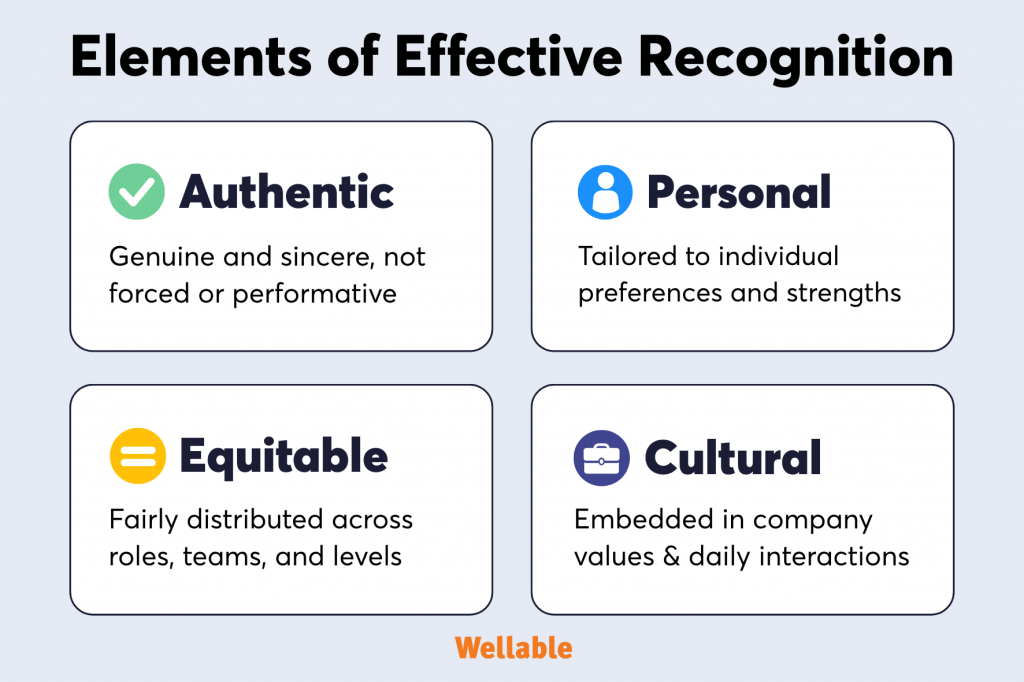
However, simply having an employee recognition program does not guarantee these outcomes. Research shows that recognition delivers the greatest impact when it is authentic, personalized, equitable, and embedded into organizational culture.
13 Best Practices for Employee Recognition Programs
Organizations can use the following best practices to deliver meaningful recognition that improves the employee experience and strengthens organizational performance.
1. Define Clear Goals
Before rolling out initiatives, organizations should identify what they want to achieve, such as increased employee engagement, improved well-being, higher retention, or enhanced productivity. While recognition can influence many aspects of the employee experience, establishing clear priorities helps create a more focused program.
In addition, organizations should set specific objectives and determine how to measure success through participation rates, employee feedback, performance metrics, or other relevant indicators. Clear goals guide a program’s design and help leaders communicate its purpose, building employee buy-in and motivation from the start.
2. Tie Recognition to Company Values
Recognition becomes even more powerful when it clearly connects to organizational values. This approach shows employees that appreciation reflects what matters most to the organization rather than popularity or sporadic praise. It also helps employees understand how their actions contribute to broader goals.
Examples of value-aligned moments to recognize include:
- Demonstrating collaboration: Covering for a teammate who is out or helping onboard a new hire reflects teamwork and accountability.
- Living the mission: Supporting a wellness initiative, such as leading a team in a wellness challenge, aligns with a commitment to employee well-being.
- Exhibiting ownership and initiative: Volunteering to lead a project, proactively solving a problem, or stepping up during a critical time demonstrates leadership.
- Fostering belonging and morale: Connecting with colleagues, building community, or encouraging a teammate supports employees’ social well-being.
- Driving results with integrity: Completing a major project or hitting a milestone while maintaining organizational standards deserves recognition.
By aligning recognition with core values, organizations help employees see how everyday actions shape culture and drive the organization forward, creating a greater sense of workplace purpose.
3. Tailor the Program to Employee Needs
There is no one-size-fits-all approach to recognition. Consider whether employees work remotely, in hybrid arrangements, or in person, since work environments influence how employees experience recognition.
Remote employees, for example, have fewer face-to-face interactions, which makes peer-to-peer recognition valuable for fostering connection and increasing visibility into team achievements. In hybrid environments, recognition can happen in silos, with some occurring in person and some online. A centralized recognition feed can help leaders share appreciation more equitably across settings.
Collect input through surveys or other feedback channels to understand workforce needs, preferences, and challenges and ensure rewards and acknowledgment remain relevant.
4. Make Recognition Timely and Regular
To build a culture of recognition, make appreciation a regular part of the work experience rather than limiting it to quarterly feedback or annual reviews. Delayed recognition misses the opportunity to reinforce positive behaviors when they occur. Acknowledging achievements promptly strengthens the connection between an action and its recognition, which can encourage employees to repeat positive behaviors.
Regular recognition also helps prevent appreciation from feeling performative or insincere. Whether it takes the form of a quick thank-you message, a shoutout during a team meeting, or a small reward, timely recognition helps employees feel genuinely seen and valued.
5. Be Specific and Personal
Recognition can occur frequently without sacrificing depth, especially when it focuses on an individual’s unique contributions and talents. Personalized praise feels earned rather than automated, which gives it greater sincerity and impact.
Generic praise such as “Great job on that report” may acknowledge an accomplishment, but it does little to explain why the contribution mattered. Effective recognition speaks directly to an employee’s strengths, contributions, and impact on team or organizational goals.
Recognition Example: “Thank you for stepping in to get this month’s sales report across the finish line while Jess was on PTO. Your positive attitude and collaboration helped us hit our deadline and exemplified the kind of teamwork we value here. Your fresh perspective also strengthened the report. You have a knack for visualizing data, and your suggestions made the final report more compelling and actionable.”
When recognition feels specific and personal, it becomes a powerful tool for building a stronger, more connected culture.
6. Recognize Efforts, Not Just Outcomes
Recognition should extend beyond major wins and work anniversaries. Highlight everyday efforts, such as personal initiative, collaboration, and resilience, that make larger achievements possible.
Research shows that when employees receive recognition for contributions outside their core job duties, they are 67% more likely to feel engaged and 74% more likely to feel connected to their organization. Recognizing behaviors such as encouraging a teammate, organizing a wellness activity, or modeling resilience under pressure reinforces a culture of genuine appreciation.
Pro Tip: Celebrate highly visible achievements while also recognizing behind-the-scenes contributions from employees in support, operations, administrative, and similar roles. Broadening recognition helps reduce perceptions of favoritism and communicates that different types of contributions matter.
7. Train Managers
Recognition from managers can have a significant influence on the employee experience, but not every manager naturally knows how to provide meaningful praise. Training gives managers a shared framework for recognizing employees consistently, authentically, and equitably.
Manager recognition training should teach leaders how to:
- Connect recognition to impact: Explain what an employee did well, why the contribution mattered, and how it supported team goals, company values, or organizational priorities.
- Personalize recognition: Adapt the message and delivery method to individual employee preferences, strengths, accomplishments, and circumstances.
- Recognize consistently and promptly: Incorporate recognition into regular management practices rather than reserving praise for major milestones or formal reviews.
- Identify and reduce bias: Monitor who receives recognition and consider whether visibility, proximity, role, work arrangement, or unconscious bias influences recognition patterns.
Organizations can also give managers a consistent framework, such as a recognition platform or company Slack channel, to track how recognition and rewards are distributed. Greater visibility into recognition patterns can help leaders identify inconsistencies and strengthen employee-manager relationships.
Pro Tip: Use real-world scenarios during manager training to demonstrate how unconscious bias can influence recognition. For example, ask managers to consider whether they consistently praise employees in highly visible roles while overlooking employees whose contributions happen behind the scenes.
8. Incorporate Rewards
Without rewards, recognition programs may struggle to gain momentum. When organizations pair recognition with monetary incentives, such as bonuses, charitable contributions, gift cards, or personalized rewards, they provide a tangible expression of appreciation that can strengthen motivation and loyalty.
Research has shown that recognition accompanied by monetary rewards is 20% more effective at reducing turnover than e-thanks alone. Rewards can also encourage employees to celebrate peers, contribute actively, and remain aligned with organizational values.
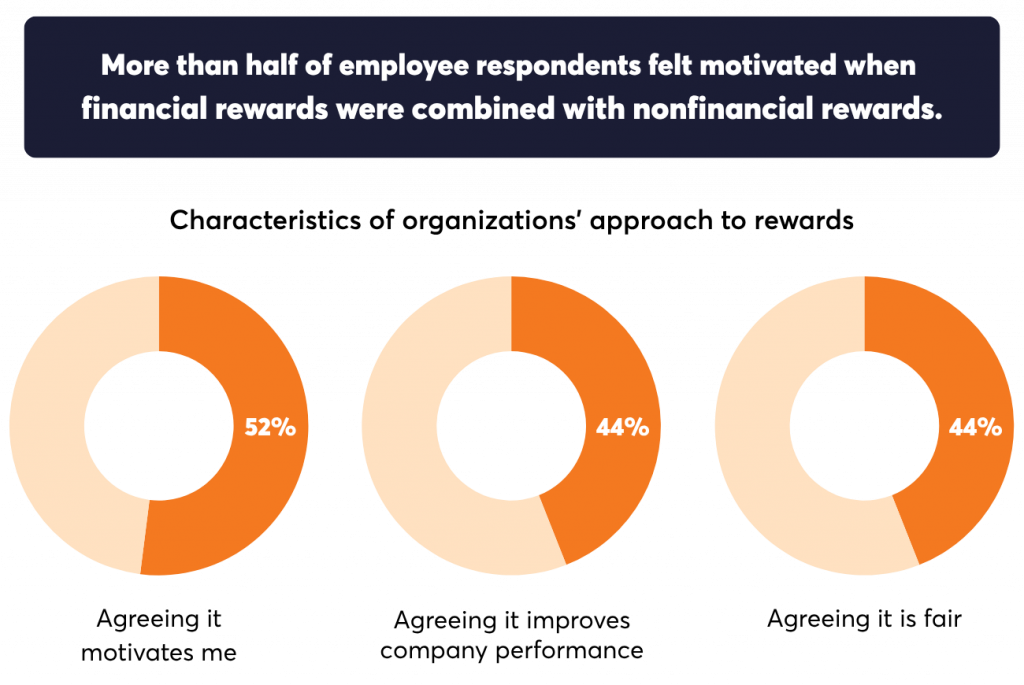
Financial rewards do not represent the only option. For example, a McKinsey survey found that, in addition to motivators like recognition and manager feedback, employers’ use of financial and non-financial rewards strongly influenced employees’ motivation and performance. Nonfinancial rewards can meaningfully complement financial incentives when they are tailored to fit individual preferences or goals. This could look like offering more workplace flexibility, extra days off, or special project assignments.
9. Implement a Rewards Budget
To make rewards sustainable, determine how the organization will fund and distribute them.
Two common approaches include:
- Provide recurring deposits into employee rewards wallets so peers and managers can send monetary tokens of appreciation.
- Allocate regular reward budgets to managers so they can recognize employees based on real-time contributions.
For organizations beginning a recognition program, allocating reward funds to managers can provide an effective starting point. This structure supports intentional distribution and allows organizations to monitor how managers use funds before expanding access.
Monthly allocations for all employees:
- Allow a consistent flow of recognition funds
- Promote sustained engagement throughout the year
- Support organizations with larger recognition budgets
- Simplify usage tracking and encourage timely distribution
Quarterly or manager-only distributions:
- Provide structure while allowing flexibility
- Accommodate smaller recognition budgets
- Help organizations start small and scale according to participation, impact, and feedback
10. Encourage Peer-to-Peer Recognition
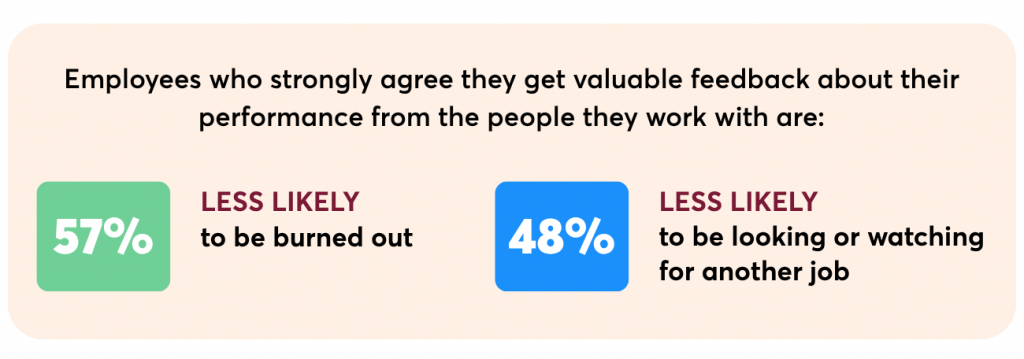
Recognition should not rely solely on top-down feedback. Peer-to-peer recognition can create a culture of mutual respect and appreciation where employees feel seen by the people they work with every day. It can strengthen relationships, foster psychological safety, and encourage collaboration across roles and departments.
Encouraging employees to acknowledge one another also supports inclusive recognition by giving managers greater visibility into positive behaviors and accomplishments they might otherwise miss, particularly among hybrid and remote teams. Tools such as a social recognition feed can make peer appreciation easier to share regularly. Over time, frequent peer recognition can strengthen belonging and team connection.
11. Communicate Regularly
Even a well-designed recognition program can struggle if employees do not understand its purpose or how to participate. Regular communication from executives and senior managers demonstrates leadership buy-in, reinforces the program’s value, and encourages participation.
Use a mix of communication channels, such as team meetings, internal newsletters, communication platforms, and intranet announcements, to keep recognition visible and relevant. Highlight recent recognitions, share meaningful examples, and feature employee testimonials to build momentum and normalize participation across organizational levels.
Pro Tip: Give managers succinct talking points about the recognition program that they can incorporate into regular team meetings and check-ins.
12. Measure Program Impact
A successful employee recognition program should evolve alongside the workforce and organizational culture. Tracking quantitative metrics and employee feedback helps leaders determine whether the program reaches employees, encourages meaningful participation, and contributes to broader workforce goals.
Use a combination of the following employee recognition program metrics:
| KPI | What It Measures | How to Track It |
|---|---|---|
| Participation rate | How widely employees use the recognition program | Track the percentage of employees who give or receive recognition during a defined period |
| Recognition frequency | How consistently recognition occurs | Measure the average number of recognitions sent or received per employee each month or quarter |
| Manager participation | How consistently managers recognize their teams | Track the percentage of managers who provide recognition and compare activity across teams |
| Recognition distribution | How equitably recognition reaches the workforce | Compare recognition rates across departments, roles, locations, work arrangements, and relevant demographic groups |
| Employee engagement | Whether recognition aligns with stronger employee sentiment and connection | Compare engagement or pulse survey results with recognition participation and employee perceptions of recognition quality |
| Retention and turnover | Whether recognition patterns correspond with employee retention | Monitor voluntary turnover and retention trends over time and compare them with recognition participation data |
Metrics reveal what happens within a recognition program, while employee feedback can help explain why. Use surveys and pulse checks to understand whether employees find recognition meaningful, authentic, equitable, and relevant. Leaders can then use these insights to improve the program by refreshing reward options, adjusting communication cadence, addressing participation gaps, or providing additional manager training.
13. Foster Inclusive Recognition
An effective recognition program should give employees across departments, roles, locations, work arrangements, and backgrounds meaningful opportunities to receive appreciation. Without intentional oversight, recognition can disproportionately flow toward employees with highly visible roles, frequent contact with leadership, or greater opportunities to showcase their accomplishments.
Organizations can foster more inclusive recognition by monitoring who gives and receives recognition, comparing participation across employee groups, and looking for patterns that may indicate gaps. Leaders should also broaden the definition of recognition-worthy contributions to include collaboration, mentorship, emotional support, operational excellence, problem-solving, and other work that may receive less visibility than revenue-generating or client-facing achievements.
Peer-to-peer recognition can further expand visibility by allowing employees to highlight contributions managers may not directly observe. Manager training can reinforce this effort by helping leaders recognize proximity bias, unconscious bias, and other factors that may influence whom they acknowledge.
Inclusive recognition does not mean recognizing everyone in the same way or at the same frequency. It means creating equitable opportunities for meaningful contributions to receive acknowledgment, regardless of where or how employees work.
Employee Recognition Program Examples: What Great Looks Like
The best employee recognition programs do more than reward accomplishments. They create consistent opportunities to acknowledge meaningful contributions, reinforce company values, and help employees recognize one another. These real-world employee recognition program examples show how organizations can put those principles into practice. They also demonstrate an important principle: there is no single formula for an effective employee recognition program. Organizations can build recognition around feedback, formal awards, company values, or a combination of approaches. The strongest programs connect recognition to the culture and behaviors the organization wants to strengthen.
Patagonia: Build Recognition Into a Feedback Culture
- What they do: Patagonia uses digital feedback to support a culture in which employees actively seek feedback from one another. According to Patagonia insights shared by Qualtrics, encouraging employees to request feedback can prompt more employees to participate in the feedback process, creating a more organic exchange among colleagues.
- Why it works: Patagonia treats feedback and recognition as part of an ongoing workplace culture rather than a one-time event. Employees play an active role in the process, which supports regular peer interaction and makes acknowledgment part of everyday work.
- Best practices demonstrated: Encourage peer-to-peer recognition, make recognition timely and regular, and tailor the program to employee needs.
Amazon: Celebrate Exceptional Contributions
- What they do: Amazon’s annual “Just Do It” award publicly recognizes employees who go above and beyond to innovate on behalf of customers. Recipients receive a Nike sneaker trophy as a lasting symbol of the achievement.
- Why it works: The award connects recognition to a specific type of contribution rather than offering generic praise. It also makes exceptional work visible to colleagues and gives the recognition a memorable, tangible component.
- Best practices demonstrated: Be specific and personal, incorporate rewards, and recognize efforts and outcomes.
Qualtrics: Connect Recognition to Company Values
- What they do: Qualtrics connects employee recognition to its TACOS values: Transparent, All-In, Customer Obsessed, One Team, and Scrappy. For example, managers can recognize employees for demonstrating resourcefulness or going above and beyond for customers, directly connecting praise to the behaviors the company wants to reinforce.
- Why it works: Values-based recognition helps employees understand not only that their contribution matters, but why it matters. It turns abstract company values into observable workplace behaviors and gives managers a clear framework for meaningful praise.
- Best practices demonstrated: Tie recognition to company values, train managers, and make recognition specific and personal.
How to Build an Employee Recognition Program
Building an effective employee recognition program starts with understanding what employees need and what the organization wants to achieve. Rather than launching individual recognition initiatives without a broader strategy, use these five steps to create a program that employees can easily understand, use, and value.
Step 1: Define Your Goals
Start by identifying the outcomes the recognition program should support. Goals might include improving employee engagement scores, reducing voluntary turnover, strengthening manager effectiveness, or increasing employees’ sense of belonging. Establish specific metrics and a baseline before launching the program. For example, rather than setting a broad goal to “improve engagement,” organizations can aim to increase a relevant employee survey score by a defined amount within a specific timeframe.
Step 2: Understand Your Workforce
Consider how and where employees work, the size and structure of teams, and how employees prefer to receive recognition. A program for a distributed workforce may require different tools and practices than one designed for employees who regularly work together in person. Survey employees before selecting a program format. Ask about recognition preferences, meaningful rewards, and potential barriers to participation.
Step 3: Choose Your Recognition Types
Determine which forms of recognition best fit company goals and culture. Options can include peer-to-peer recognition, manager-to-employee recognition, milestone celebrations, values-based awards, and performance-based rewards. Combining multiple recognition types can create more opportunities to acknowledge different contributions across the employee experience.
Step 4: Select Tools and Set a Budget
Choose how employees will give, receive, and track recognition. Depending on the organization, this could involve an employee recognition platform, communication channel, or other centralized system. Then establish a sustainable rewards budget. Decide who can distribute rewards, how much funding they receive, and how often allocations renew. Clear guidelines help organizations manage costs while keeping rewards accessible and meaningful.
Step 5: Launch, Measure, and Iterate
Before launch, train managers on meaningful recognition and clearly communicate how the program works. Explain its purpose, available recognition options, and how employees can participate. After launch, track metrics such as participation, recognition frequency, manager involvement, employee engagement, and recognition distribution. Pair these insights with employee feedback to identify gaps and refine the program over time.
Creating a Culture of Recognition with Wellable
Wellable is an all-in-one solution for employee wellness, rewards, and recognition—a one-stop shop for enhancing the employee experience and driving engagement.
Wellable’s recognition and rewards solutions empower teams to effortlessly acknowledge achievements and allocate rewards. From celebrating employee anniversaries and birthdays to rewarding achievements and needle-moving efforts, everything is centralized in one, comprehensive platform.
Frequently Asked Questions
-
Share
-

-

-

-