Wellness
 Rewards
 Recognitions


 Learn more about Wellable's all-in-one
employee engagement platform
Learn more about Wellable's all-in-one
employee engagement platform





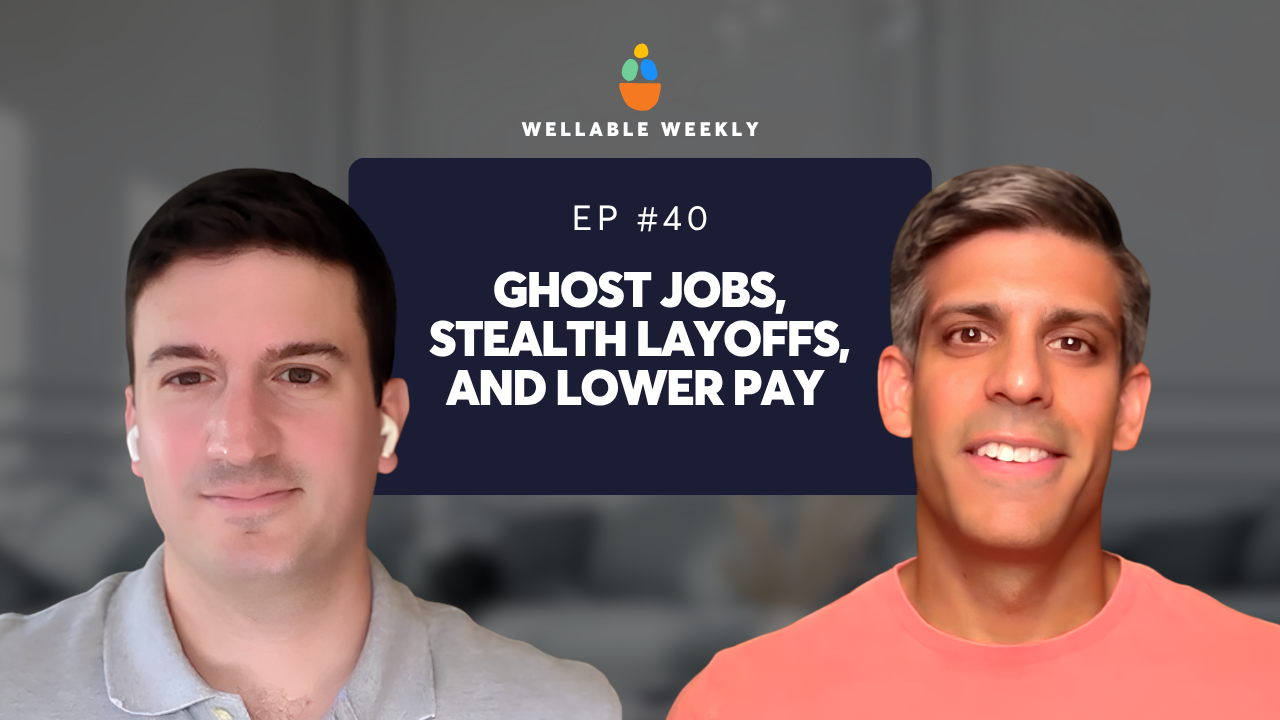
In this week’s episode, Nick and Geoff dig into a landmark Stanford study, which revealed that the AI tools many employers use to screen job applicants are introducing racial bias and locking the same candidates out of opportunities across multiple companies. They also discuss Uber’s announcement that it’s cutting 23% of its HR workforce. While the company claims AI has nothing to do with it, it may be hard to take at face value.


Short on time? Here are the key takeaways:
- 90% of US employers use AI screening tools to rank applicants, and most rely on the same few third-party models, creating what researchers call “algorithmic monoculture,” where a single rejection can cascade into rejection everywhere
- A Stanford HAI study covering 3.4 million applicants and 4 million job applications found AI hiring tools are producing significant racial bias and correlated rejections across employers using the same model
- AI hiring tools differ from human recruiters in four critical ways: pervasive adoption across employers, persistent memory across applications, high-stakes consequences, and opacity—properties that create systemic risks candidates cannot see or contest
- Application volumes have tripled as AI makes it easier than ever to apply for jobs, creating a capacity crisis that pushes HR teams toward AI screening even as the risks emerge
- Uber is cutting 23% of its HR team while denying it is AI-driven, but the timeline—aggressive AI spending, a blown Q1 AI budget, and an admission of unclear ROI—makes that explanation difficult to accept
Episode Summary
The Stanford Study That Should Change How You Think About AI Hiring
Ninety percent of US employers now use AI tools to screen and rank job applicants. The more consequential detail is what follows from it: the majority of those employers are using the same small number of third-party AI models, which means the hiring decisions of thousands of companies are running through the same algorithmic infrastructure.
The Stanford HAI study that Nick and Geoff discuss is the first large-scale empirical examination of what that infrastructure is actually doing. The numbers are significant: 3.4 million applicants, 4 million job applications, 1,700 job postings, 150 employers across 11 industries. What the study found is that a major problem is embedded in how these tools work. The article coins the term “algorithmic monoculture” which gives way to a significant increase in racial bias relative to human screening.
The term comes from agriculture. A monoculture farm plants a single crop strain. When every farm does this, one disease can wipe out the entire supply because there is no diversity to absorb the shock. Applied to hiring, the logic is identical. When every employer uses the same AI model, a rejection at company A is not an independent event from a rejection at company B. The same algorithm, seeing the same profile, can makes the same call regardless of a completely new application or role. A candidate who gets screened out for one position can find themselves locked out across many other companies running that model, even if their skills are a strong fit for several of those roles. The employer loses a good candidate they never considered. The candidate never gets a chance to be considered.
Why AI Hiring Tools Are Structurally Different from Human Recruiters
Nick draws a distinction that is worth sitting with. In a world of human recruiters, a rejection at company A is genuinely independent from a rejection at company B. The recruiters are different people, evaluating the same resume with different contexts, different hiring mandates, and different moments in their own thinking. Even if they reach the same conclusion, they reach it separately.
AI tools break that independence. Nick identifies four properties that make AI hiring models structurally different from the human process they are replacing. First, pervasive adoption: when the same model is used across hundreds of employers, it encounters the same applicant multiple times in ways no human recruiter ever would. Second, persistent memory: unlike a recruiter who reviews a resume fresh, the model carries data about previous interactions with that profile. Third, high-stakes consequences: a rejection from an AI screening tool is not just a lost opportunity at one company but potentially a correlated rejection across an entire market. Fourth, opacity: candidates have no visibility into why they were rejected or how the model weighted their profile.
None of those properties individually would disqualify AI from a role in hiring. But in combination, they create a system that is fundamentally different from human-led recruiting in ways that are not obvious to employers or applicants, and that are actively harmful in the ways the Stanford study documents.
Uber’s HR Cuts and the Question Nobody Is Asking
The second story is Uber’s announcement that it is cutting 23% of its HR workforce. Uber’s CEO stated explicitly in an internal memo that the changes are not AI-driven, describing them instead as necessary to maximize the effectiveness of the people team. Nick and Geoff are skeptical.
The context makes the denial hard to accept. In the weeks leading up to the layoff announcement, Uber had been prominently in the news for three separate AI-related stories: a public commitment to using AI to optimize the business, a report that the company blew through its entire AI budget in the first three months of the year, and a CTO statement acknowledging the company does not yet have a clear or demonstrable ROI from its AI spend. The sequence paints a picture of a company that made aggressive AI investments, could not show results, and is now cutting costs, with HR, a function that has a middle-management-adjacent structure and is therefore a common target in AI-era restructuring, absorbing a significant share of those cuts.
Whether Uber’s HR cuts are technically AI-driven or not, they are happening in an environment where the public narrative around AI has made cutting people-facing functions easier to justify. The more useful question is not what Uber calls the layoff but whether the core HR functions are still going to be owned and performed by someone. Nick’s analogy to wellness programs is apt: the question is not whether you have a dedicated wellness coordinator but whether someone owns the program. The same logic applies to HR. The title and reporting structure can change. The work cannot disappear.
Frequently Asked Questions
The Stanford Human-Centered AI study examined 3.4 million applicants, 4 million job applications, 1,700 job postings, 150 employers, and 11 industries, making it the first large-scale empirical study of AI hiring. It found two major problems: a significant increase in racial bias relative to human screening, and a pattern of correlated rejections across employers using the same model, meaning candidates screened out by one company’s AI tool were systematically more likely to be rejected by others using the same system.
Algorithmic monoculture describes what happens when most employers use the same small number of AI models to screen applicants. Borrowed from agriculture, where planting a single crop strain creates vulnerability to a single disease, the concept applies directly to hiring: when the same model sees the same resume across multiple employers, a rejection at one company is no longer independent of rejections elsewhere. A candidate who is a strong fit for several roles can be locked out of all of them because a single algorithm does not like their profile.
AI tools have made it dramatically easier and faster for job seekers to apply for positions, including generating customized resumes and cover letters at scale. Application volumes at many companies have tripled as a result. That volume surge is one of the primary reasons employers are turning to AI screening tools, creating a cycle where AI-generated applications are being evaluated by AI screening models, largely without human review at the initial stage.
Uber’s CEO stated explicitly that the 23% HR workforce reduction is not AI-driven. Nick and Geoff take that claim with skepticism, noting that in the weeks before the announcement, Uber had been in the news for aggressive AI spending, a blown AI budget in Q1, and a CTO admission of unclear AI ROI. Whether or not the cuts are formally attributed to AI, they fit a pattern of companies using the favorable AI narrative to restructure functions that have a middle-management-adjacent profile.
Nick and Geoff suggest that the most likely near-term response from HR teams is not to abandon AI screening tools but to work with vendors on configuration, bias auditing, and transparency. The volume problem that drives AI adoption is not going away. The more durable solution requires pressure on AI vendors to allow employer-level configuration, provide explainability for screening decisions, and build in safeguards against correlated rejection patterns.
Yes, in the sense that the underlying work HR performs, payroll, compliance, benefits administration, employee relations, culture maintenance, has to be owned by someone regardless of how the function is structured or titled. The question is not whether to have HR but how to ensure those responsibilities are clearly assigned and resourced. Nick’s analogy to wellness programs applies: a wellness program without a clear internal owner will fail, not because the software is bad but because no one is accountable for making it work.
Full Episode Transcript
Nick: Welcome to the Wellable Weekly Podcast, where we talk about key topics and trends at the intersection of well-being, technology, and HR. I’m Nick, along with my good friend and colleague Geoff.
All right, hopping into it — another AI article to kick us off. What’s good about this is that it’s not just an article, it’s actually a study, which I find really interesting. It’s from the Stanford University Human-Centered AI group, Stanford HAI. To set the foundation: a big part of our audience is involved in recruitment and retention, and an interesting stat from this study was that 90% of US employers use AI screening tools to sort and rank job seekers. That blew my mind. I know AI is really popular, and I always feel like as a company we’re fairly ahead of the times. We don’t do that. So I saw 90% and it was a curveball. I don’t understand how 90% of companies do anything — that’s a ton of alignment.
What’s probably more interesting, going a layer deeper, is that the majority of those companies are working with the same few third-party models and vendors. So as an applicant, if I apply to 10 jobs, and I can now generate customized resumes and cover letters using AI — so I’m applying to more jobs than ever — and 5 of those 10 companies are using the same AI model, that model has now seen my resume five different times. Because it sees it multiple times, it’s using some of that prior data to render an opinion about me for each new position. Whereas in the real world without AI, you’d have five HR people at five different companies reviewing my resume each independently.
The study covered 3.4 million people who submitted 4 million job applications, across 1,700 job postings, 150 employers, and 11 industries. It’s the first large-scale study of AI hiring, which makes it especially compelling. It found two major issues: a significant increase in racial bias, and a tendency to shut the same people out of jobs everywhere they apply. If you’re rejected from the first position, that rejection plays a factor in future applications to companies using the same model, and you can get effectively locked out even if you’re a strong fit. That’s bad for employers who miss good candidates and bad for employees who never get the chance to interview.
Geoff: A few interesting stats worth unpacking. The applications across 1,700 job postings — that’s over 2,000 applications per job posting. That’s actually not that uncommon for larger companies that are appealing to new graduates looking for secure work with compelling benefits and pay. Because of that volume, and the ease with which people can apply now, it’s created a perfect storm of increased applications. In order to handle that volume, organizations are resorting to tools powered by a select few AI models.
The term the article coins to describe this effect is algorithmic monoculture. That term actually comes from farming. The basic premise is that if every farm plants the same single crop strain, one disease could wipe everything out because there’s no diversity. The same logic applies here. When every employer uses the same AI vendor for screening, rejection decisions become correlated. Normally, applying to company A and company B should produce independent decisions. But if they’re running the same algorithm and that algorithm doesn’t like your profile, they can reject you for the exact same reason across the board. Most applicants aren’t even aware this could be happening when they submit their applications.
Nick: Just one detail about the study worth noting: all the applications in this study were processed through the same AI hiring tool, so they could confirm every application was going through the same algorithmic model. That makes the findings cleaner.
I always think about the concept of AGI — artificial general intelligence — which refers to AI that can be intelligent the way a human is. In an ideal world, an AI hiring tool would work like a recruiter who reviews each application independently. But a recruiter at company A is looking at a resume for the first time, and a recruiter at company B is also looking at it for the first time. Those evaluations are independent of each other.
That independence disappears when it all feeds into a single model. These AI tools have four properties that fundamentally distinguish them from human recruiters: they’re pervasively adopted across many employers simultaneously, they have persistent memory across applications, their decisions are highly consequential, and they’re opaque — neither candidates nor employers can see exactly how decisions are being made. Even if AI were capable of true AGI-level reasoning, those properties create problems that don’t exist in the human recruiting process.
Solving it is not straightforward. You could tell HR teams: if you see a resume that appeared in a prior screening, clear your history. But I don’t know if that works, because I don’t know if the problem is the memory or if the same model would just produce the same output regardless.
Geoff: Right. The natural instinct for an HR leader reading this study is probably not to ditch the tool altogether but to look for configuration tweaks that preserve the efficiency gains. Given the volume of applications organizations are receiving every day, I don’t think many will abandon AI screening entirely. Some of the onus has to fall on the AI vendors to allow employer-level configuration and actually have those configurations affect how memory and screening are conducted. But I’m not sure how much will change quickly.
Nick: It’s a tough place to be in HR. Even if your team stayed the same size, 3x the applications means you’re not equipped to handle that volume without AI. So there’s a real need for a solution. AI is the natural one. There are clearly real challenges with it, as this study shows. But just powering through triple the applications manually doesn’t seem like the right answer either.
Which actually dovetails into our next story. Uber is planning to lay off 23% of its HR workforce. Before we get into the details — Uber has explicitly said this is not AI-driven, which is very different from almost every other layoff you’ve seen in the news lately. It’s hard to completely believe that, because Uber has been disproportionately in the news lately. First for its very strong stated intention to use AI to optimize its business. Then a report that they blew through their AI budget in the first three months of the year. Then the CTO came out and acknowledged they don’t have a very clear or demonstrable ROI from their AI spend. So before you hear about the layoff, what you know is that they’re spending aggressively on AI and don’t have much to show for it, which means they’re probably looking for cost savings.
In this new environment, it feels like everyone is cutting middle managers. HR doesn’t have middle managers in the strict sense, but it has a middle-manager-adjacent dynamic of managing people and processes that makes it a common target. The CEO, in an internal memo, said the changes are necessary to maximize the effectiveness of the people team and the enormous potential ahead. That’s vague enough to mean almost anything. They later explicitly said this is not AI-driven, but I understand why that’s met with some skepticism.
Geoff: Actions speak louder than words, in its most basic form. There’s so much scrutiny and skepticism around C-suite intentions and how layoffs are being communicated. We talked about this with the Bolt CEO, Ryan Breslow, making a big announcement about getting rid of his entire HR team — but he still had people ops covering those functions. You simply have to have these functions covered. Someone needs to own core people-related processes for the business to run smoothly. You can reframe it as HR versus people operations, that’s fine. But cutting the processes out entirely is not sustainable. It’s about how you structure it to make sure those things are still getting done.
Nick: A similar analogy: I often get the question of whether a company should hire a dedicated wellness coordinator. And I come back to: what you really need is someone to own the wellness program. That could be a single person with wellness in their title, or it could be a wellness committee, or an HR benefits person who’s really engaged with wellbeing and wants to own the process. What you can’t do is launch wellness software without any true internal owner, because it will flop. Someone has to own it. The same logic applies to HR. Yes, it could be traditional HR. But the reality is all these processes need an owner — whether that’s HR, managers, or a combination. Uber is a sophisticated company. They’re not going to forget payroll or benefits. They’re just trying to distribute those responsibilities differently, probably eliminating the middle layer and pushing ownership directly to managers and the rank and file.
Geoff: Yeah, makes sense. Well, that seems like a good place to wrap up. Thanks as always for tuning in. You can catch us on Spotify, Apple Podcasts, or wherever you get your podcasts. And be sure to subscribe to Wellable Weekly for all of our latest insights. Thank you.
-
Share
-

-

-

-